
5 Things We Learned This Week - 1/11/2026
Submitted by Silverlight Asset Management, LLC on January 11th, 2026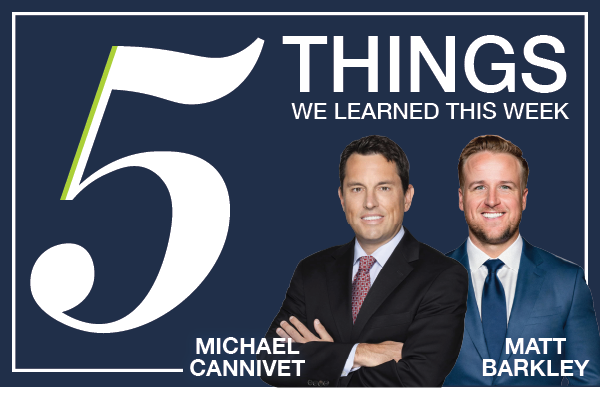
January 11, 2026
The S&P 500 rose 1.6% this week. The Bloomberg Aggregate Bond Index rose 0.3%, Gold jumped 4.1% and Bitcoin rose 0.4%.
ISM Manufacturing fell to 47.9 in December, marking the weakest print in over a year. The ISM Services index jumped to 54.4, beating the 52.2 consensus and exceeding all forecasts. The strength in services complicates the Fed's easing path, suggesting demand is resilient in much of the economy. December nonfarm payrolls rose 50k which was slightly lower than expectations. Initial jobless claims remained in a normal range at 208K, but continuing claims ticked higher, hinting that finding jobs is getting harder.

The Stimulus Party Has Started

Regular readers know this blog has forecasted that 2026 will be a year of Fire and Ice. Our base case has been that the Trump administration would be willing to run the economy hot into the midterm elections using aggressive stimulus. This week offered a clear preview of how far policymakers may be willing to go.
The economic ideas oozing from Truth Social this week were hard to keep up with. First, Trump said he plans to restrict private equity firms from investing in residential real estate, effectively reshaping housing demand by decree. Trump later announced he plans to pressure Fannie Mae and Freddie Mac to step up purchases of mortgage-backed securities with the explicit goal of pushing mortgage rates lower. Then, toward the end of the week, Trump floated the idea of capping credit card interest rates at 10%. We don't know how many of these measures will go through, but it’s clear the President's economic toolkit has expanded well beyond what’s considered normal.
Historically, Washington has used heavy-handed economic decrees like this sparingly. Housing finance manipulation is nothing new, but it's usually left to supposedly independent agencies like the Federal Reserve. And credit controls like interest-rate caps are typically associated with crisis periods or emerging markets, not late-cycle U.S. expansions.
That being said, our macro thesis for this year is already starting to play out. Expect more stimulus announcements between now and November. This will likely be initially bullish for growth and risk assets. Longer term, however, overstimulating an already tight economy will probably cause uncomfortably high inflation. This will probably lead to much tighter liquidity—and that’s the “ice” scenario investors need to be ready to hedge once the temperature starts dropping.

Trump's Economic Policies Are Anything But Conservative

For decades, Republicans have branded themselves as the party of smaller government, freer markets, and limited economic intervention. Democrats, by contrast, have generally favored a larger state footprint, more regulation, and greater central planning. That’s what makes the current policy mix so striking. While Donald Trump campaigned on shrinking government and “draining the swamp,” his economic playbook looks anything but conservative.
Most Republicans are against higher taxes, but tariffs are a tax on trade. Leaning on the Fed to cut rates and pressuring agencies to buy mortgage bonds undermines central bank independence. Pushing the government to take stakes in private companies like Intel blurs the line between public and private enterprise. Layer on this week’s new proposals and the overall direction is clear: This administration favors heavy-handed government intervention over the private sector.
In many ways, the current US economic policy resembles a state-directed model closer to China’s than the traditional American system. Markets may cheer certain measures in the short-term, but there are longer-term risks worth thinking about, too. Centrally planned economies tend to see higher levels of inflation, capital misallocation, and lower productivity. Why is the US moving toward this model? And if the US keeps moving in this direction, will the S&P 500 continue to trade at a much higher P/E ratio than the rest of the world?
History offers warnings. In the 1970s and 1980s, the Soviet Union poured resources into a centrally planned, over‑militarized, state‑dominated economy. They initially sustained headline growth, but eventually collapsed under the weight of inefficiency, shortages, and stagnation when the system’s distortions finally caught up. Japan’s late-1980s experiment with easy money and government-fueled growth ended in an epic asset bubble and decades of stagnation. Investors should treat these experiences as a possible preview for what's ahead. When a major power abandons market discipline for political control over prices, credit, and investment, the short‑term sugar high often ends in long‑term damage to growth, profits, and asset valuations.

Countries Are Competing For Commodities

President Trump’s expansionist rhetoric—whether aimed at Greenland or Venezuela—has rattled diplomats and left a lot of investors scratching their heads. Two things these countries have in common are abundant natural resources and strategic importance.
That raises an important question for investors: if countries are increasingly competing for natural resources, does that imply commodities are likely undervalued?
We think the answer is yes.
Commodities have spent much of the last decade in a bear market, which led to chronic underinvestment. Capital fled mines, drill sites, and processing capacity in favor of software, services, and passive financial assets. That was rational—until it wasn’t.
Now the world is shifting. A breakdown in rules-based global trade is forcing nations to think defensively. Strategic stockpiling suddenly makes sense when alliances feel fragile. At the same time, AI is pouring gasoline on demand for energy, copper, rare earths, and precious metals. Dr. Copper doesn’t lie—and neither does gold quietly making new highs. Supply can’t respond overnight. Years of underinvestment don’t reverse on a press release. When demand accelerates into a constrained system, prices usually do the adjusting.
Markets may still be pricing commodities for yesterday’s world, not tomorrow’s.

Tempus AI Thesis To Own

What if the most valuable healthcare company of the next decade isn’t a drug maker—but the operating system that tells every doctor which decision is right, and when? If Tempus AI scales to its fullest ambition, it becomes the timekeeper of medicine itself: an AI-driven intelligence layer that meaningfully reduces misdiagnosis, improves outcomes, and reshapes how trillions of dollars flow through healthcare.
Tempus already sits at the center of this vision. Beneath the surface of genetic testing revenue lies one of the largest proprietary clinical datasets ever assembled, spanning multimodal genomics, imaging, and outcomes data. With that foundation, Tempus is evolving from a lab services business into a decision-making platform—one that pharma companies, hospitals, and clinicians increasingly depend on.
That dependence is precisely what makes Tempus a high-quality stock. Platform companies compound advantages: more users create more data, more data improves outcomes, and better outcomes attract more users. Tempus’s scale, embedded partnerships, and regulatory foothold create a data moat that grows wider with time—exactly the pattern seen in history’s most valuable platforms.
At today’s share price, the market is discounting execution risk while under appreciating duration. If growth persists and margins expand, today’s valuation looks far more reasonable in hindsight.
Finally, timing matters. After a sharp pullback from highs, improving fundamentals and a long runway converge. For patient, risk-tolerant investors, Tempus AI looks attractive at its current price. Silverlight recently initiated a new position in Tempus AI.

When People Show You Who They Are, Pay Attention

In 2015, many investors, employees, and partners believed Elizabeth Holmes when she promised that Theranos would revolutionize blood testing. Her words were confident, visionary, and reassuring. But her actions—secrecy, intimidation, and falsified results—told a different story. Red flags were raised and ignored, and the cost was enormous: reputations ruined, money lost, and patient trust broken. The Theranos story is now a cautionary tale of what can happen when we listen too much to someone's words and discount their behavior.
The lesson is timeless: when people show you who they are, pay attention.
Relational wellbeing—the health of your connections with others—rests on trust, consistency, emotional safety, and mutual respect. Clear-eyed relationships create calmer nervous systems, better boundaries, and deeper fulfillment.
Three simple ways to evaluate a relationship:
- Track patterns, not apologies. Change shows up in behavior.
- Notice how you feel after spending time with people. Energized or drained?
- Check alignment. Do their actions support your values—or collide with them?
By seeing people for who they truly are—rather than projecting idealized versions—we foster healthier connections. This clarity helps avoid toxic dynamics, build authentic bonds, and prioritize relationships that uplift rather than drain us. Actively managing relationships can help us improve our emotional health and overall life satisfaction.
This material is not intended to be relied upon as a forecast, research or investment advice. The opinions expressed are as of the date indicated and may change as subsequent conditions vary. The information and opinions contained in this post are derived from proprietary and non-proprietary sources deemed by Silverlight Asset Management LLC to be reliable, are not necessarily all-inclusive and are not guaranteed as to accuracy. As such, no warranty of accuracy or reliability is given and no responsibility arising in any other way for errors and omissions (including responsibility to any person by reason of negligence) is accepted by Silverlight Asset Management LLC, its officers, employees or agents. This post may contain “forward-looking” information that is not purely historical in nature. Such information may include, among other things, projections and forecasts. There is no guarantee that any of these views will come to pass. Reliance upon information in this post is at the sole discretion of the reader.
Testimonials Content Block
More Than an Investment Manager—A Trusted Guide to Financial Growth
"I’ve had the great pleasure of having Michael as my investment manager for the past several years. In fact, he is way more than that. He is a trusted guide who coaches his clients to look first at life’s bigger picture and then align their financial decisions to support where they want to go. Michael and his firm take a unique and personal coaching approach that has really resonated for me and helped me to reflect upon my core values and aspirations throughout my investment journey.
Michael’s focus on guiding the "why" behind my financial decisions has been invaluable to me in helping to create a meaningful strategy that has supported both my short-term goals and my long-term dreams. He listens deeply, responds thoughtfully, and engages in a way that has made my investment decisions intentional and personally empowering. With Michael, it’s not just about numbers—it’s about crafting a story of financial growth that has truly supports the life I want to live."
-Karen W.
Beyond financial guidance!
"As a long-term client of Silverlight, I’ve experienced not only market-beating returns but also invaluable coaching and support. Their guidance goes beyond finances—helping me grow, make smarter decisions, and build a life I truly love. Silverlight isn’t just about wealth management; they’re invested in helping me secure my success & future legacy!"
-Chris B.
All You Need Know to Win
“You likely can’t run a four-minute mile but Michael’s new book parses all you need know to win the workaday retirement race. Readable, authoritative, and thorough, you’ll want to spend a lot more than four minutes with it.”
-Ken Fisher
Founder, Executive Chairman and Co-CIO, Fisher Investments
New York Times Bestselling Author and Global Columnist.
Packed with Investment Wisdom
“The sooner you embark on The Four-Minute Retirement Plan, the sooner you’ll start heading in the right direction. This fun, practical, and thoughtful book is packed with investment wisdom; investors of all ages should read it now.”
-Joel Greenblatt
Managing Principal, Gotham Asset Management;
New York Times bestselling author, The Little Book That Beats the Market
Great Full Cycle Investing
“In order to preserve and protect your pile of hard-earned capital, you need to be coached by pros like Michael. He has both the experience and performance in The Game to prove it. This is a great Full Cycle Investing #process book!”
-Keith McCullough
Chief Executive Officer, Hedgeye Risk Management
Author, Diary of a Hedge Fund Manager
Clear Guidance...Essential Reading
“The Four-Minute Retirement Plan masterfully distills the wisdom and experience Michael acquired through years of highly successful wealth management into a concise and actionable plan that can be implemented by everyone. With its clear guidance, hands-on approach, and empowering message, this book is essential reading for anyone who wants to take control of their finances and secure a prosperous future.”
-Vincent Deluard
Director of Global Macro Strategy, StoneX
